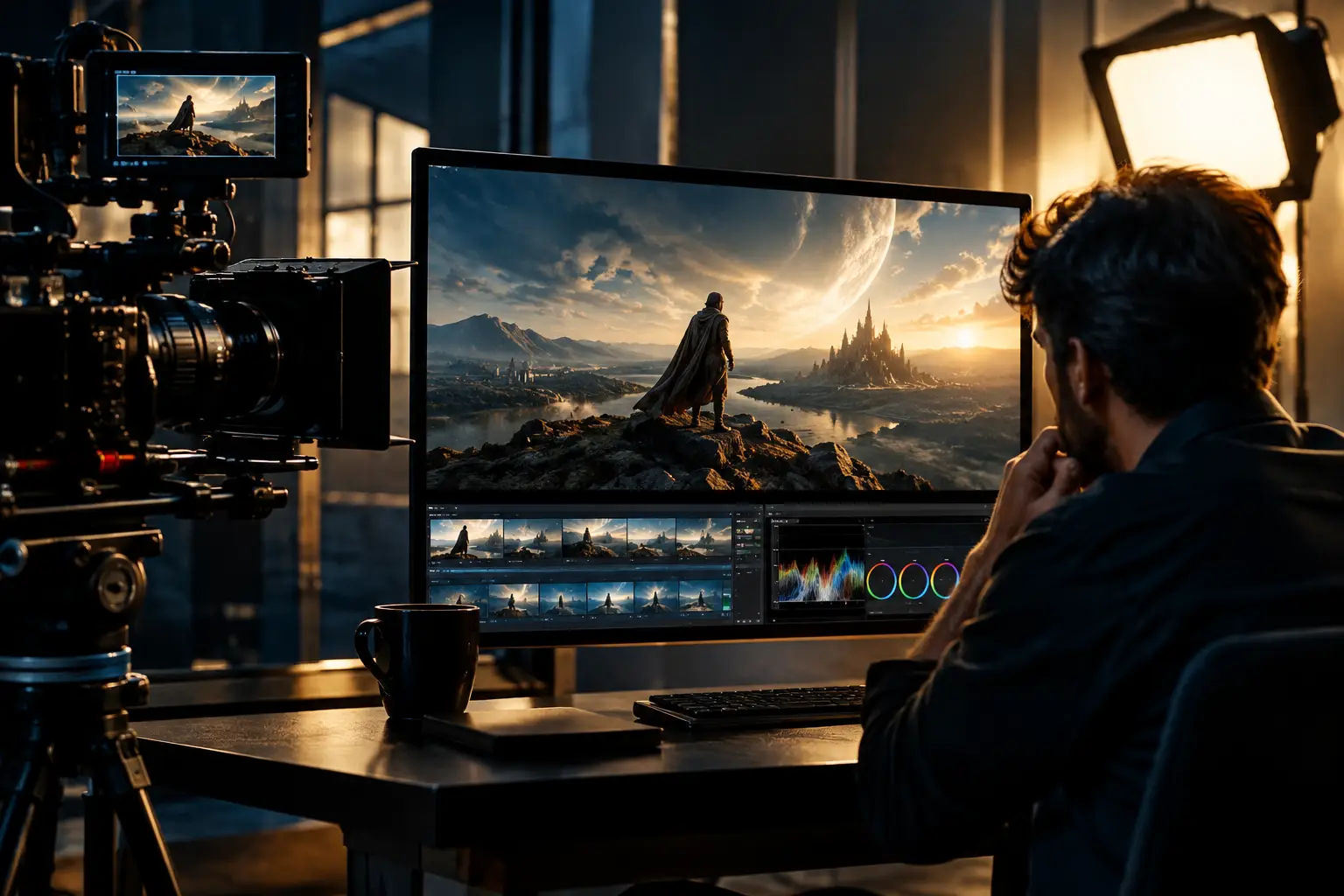
A screenplay can read beautifully and still be difficult to sell in a room. A novel can have a devoted early audience and still leave a producer asking what the film feels like. AI movie trailer production gives development-stage intellectual property a visual answer: a cinematic short-form film that establishes tone, genre, stakes, and commercial potential before a full production exists.
For screenwriters, authors, producers, and entertainment entrepreneurs, that distinction matters. A trailer is not simply a promotional edit. When it is built around an unproduced project, it becomes a proof-of-concept asset - one that helps viewers see the project, feel its world, and understand why it deserves the next conversation.
What AI Movie Trailer Production Actually Creates
The strongest AI-powered trailers are designed as original cinematic experiences, not as a sequence of attractive images attached to a logline. They translate the core dramatic promise of an IP into a focused visual narrative. The viewer should quickly understand the emotional temperature of the story, the type of audience it is built for, and the question that will pull them toward the larger project.
That may mean a dark, atmospheric teaser for a contained psychological thriller. It may mean a high-concept movie pitch trailer that makes a speculative world feel immediate and expensive. For a book adaptation, it can reveal the scale, characters, and visual language that a publisher, producer, or prospective audience may struggle to imagine from a synopsis alone.
The deliverable can take several forms depending on the stage of development. A teaser is often built around mood and intrigue. A full trailer carries more story momentum, using character, escalating conflict, title treatment, music, sound design, and a decisive final image. A proof-of-concept film goes further, demonstrating how a key sequence or dramatic premise could play on screen.
The format should follow the objective. An investor-facing asset may need to make scope and audience positioning clear. A package for producer outreach may need to foreground the hook and the creative identity of the project. An early audience campaign may benefit from a trailer that prioritizes emotion and shareability over plot explanation. There is no single right trailer length or structure. There is only the version that serves the next meaningful decision.
Why a Written Pitch Often Needs a Cinematic Asset
Development is full of abstraction. Writers discuss comparable titles, producers describe target demographics, and authors explain an imagined adaptation. Those tools are useful, but they demand effort from the person on the receiving end. A cinematic trailer reduces that distance.
Instead of asking a potential collaborator to picture the project, a well-produced trailer gives them an immediate experience of it. They can see the tension in the setting, the scale of the premise, the pace of the genre, and the kind of marketing language the eventual release might use. That is especially valuable when the project depends on a specific atmosphere, a visual world, or a tonal combination that is hard to summarize in a deck.
A trailer also creates a more tangible conversation around an intangible asset. It can support a pitch meeting, anchor a lookbook or presentation, help align creative partners, and provide a polished centerpiece for a campaign. It does not replace a screenplay, treatment, pitch deck, or financing strategy. It makes those materials more memorable by giving the story a cinematic point of entry.
This is where quality becomes non-negotiable. If the asset feels generic, inconsistent, or disconnected from the source material, it can create hesitation rather than momentum. Hollywood-quality presentation signals that the creator understands the market and has considered the project beyond the page. The trailer must earn attention quickly, then reward it with a clear creative point of view.
The Difference Between Generative Footage and Production
AI can generate visuals. That alone is not movie trailer production.
A credible trailer requires creative development, not just image generation. The production team must identify the central hook, select the scenes or moments that best communicate it, build a visual language, shape a script or trailer copy, direct character and environmental choices, and establish a rhythm that rises toward a payoff. Music, sound design, editorial pacing, typography, and finishing all carry narrative weight.
Consistency is another major consideration. Characters need to feel like the same people from shot to shot. The world needs an intentional design vocabulary. A period story, crime thriller, faith-based drama, romantic fantasy, or science-fiction epic each needs a different visual and editorial grammar. Without that discipline, even striking individual shots can feel like a disconnected montage.
There is also a strategic layer. Some projects should show the protagonist immediately; others benefit from withholding them. Some trailers need to clarify the premise in the first ten seconds; others can lead with a visceral set piece. A broad commercial concept may require a clear genre promise, while an elevated festival-oriented film may need more restraint. These are production decisions, not software settings.
A done-for-you studio process brings those decisions into one managed workflow. Rather than asking a creator to coordinate writers, visual artists, editors, sound specialists, and finishing resources, the studio develops the asset from concept through final delivery. That keeps the work aligned with the actual business purpose: creating a film that presents the IP at a professional standard.
Building a Trailer Around the Right Promise
The best trailers do not attempt to tell the entire story. They make a promise the full story can fulfill.
That promise usually sits at the intersection of premise, emotion, and market position. A survival thriller may promise escalating dread. A family animation concept may promise wonder and warmth. A prestige drama may promise a difficult moral choice. A fantasy adaptation may promise entry into a world viewers have not seen before. Once that promise is defined, every frame should reinforce it.
Source material should guide the work, but it cannot simply be compressed. A novel may contain five major subplots, multiple points of view, and a long emotional arc. A trailer needs one clean throughline. A screenplay may include scenes that work perfectly in a feature but reveal too much when isolated. The trailer structure has to protect mystery while still making the project legible.
This is also why a concept trailer should not imitate a current hit too closely. Comparable films can clarify audience and commercial lane, but imitation weakens the identity of the project. The goal is to communicate familiarity at the level of genre while preserving the originality that gives the IP value.
A Production Process Built for Development-Stage IP
A strong process begins with materials that reveal the project from several angles: the screenplay, manuscript, treatment, pitch deck, character notes, tone references, audience goals, and intended use of the finished asset. The more clearly the production team understands the project’s emotional engine, the more deliberate the trailer can become.
From there, the concept is distilled into a trailer strategy. This defines the trailer’s purpose, central dramatic question, selected story beats, visual approach, and tone. A cinematic script or voiceover may be developed if it serves the format. In other cases, sparse dialogue, on-screen text, and sound design create more impact than narration.
Visual development then gives the project its screen identity. The team establishes characters, locations, wardrobe, lighting, cinematography, and key moments with an eye toward continuity and scale. Editorial shapes those components into momentum. The final stages - score, sound design, color, titles, and finishing - are where an assembly of scenes becomes a cohesive cinematic asset.
The advantage of AI-powered production is not that it removes the need for judgment. It allows ambitious visual development without the logistics and cost structure of a conventional shoot. For the right project, that can make a movie pitch trailer, book-to-film trailer, or proof-of-concept film possible at the moment it can create the most leverage.
Blackline Creative Group approaches that opportunity as a production assignment, not a content exercise. The objective is a finished film that gives your story the weight, atmosphere, and market-facing presentation it needs for the next stage.
When a Trailer Is Worth the Investment
A cinematic trailer is most useful when a project has reached a point where words alone are no longer enough. Perhaps a screenplay is ready for producer outreach. Perhaps an author is building an adaptation package. Perhaps a filmmaker needs to demonstrate a visual approach before pursuing financing. Perhaps a creator has a strong premise and needs a professional asset to validate audience response.
It is less useful when the story itself remains undefined. AI movie trailer production can sharpen a developed concept, but it cannot solve an unclear premise or replace foundational story work. If the protagonist, stakes, genre, or audience are still in flux, the better move may be to resolve those questions first.
When the core is ready, however, a trailer can change the quality of the conversation around the project. It gives people something to watch, react to, share, and remember. For a story waiting to move from possibility to momentum, that is often where the next chapter begins.