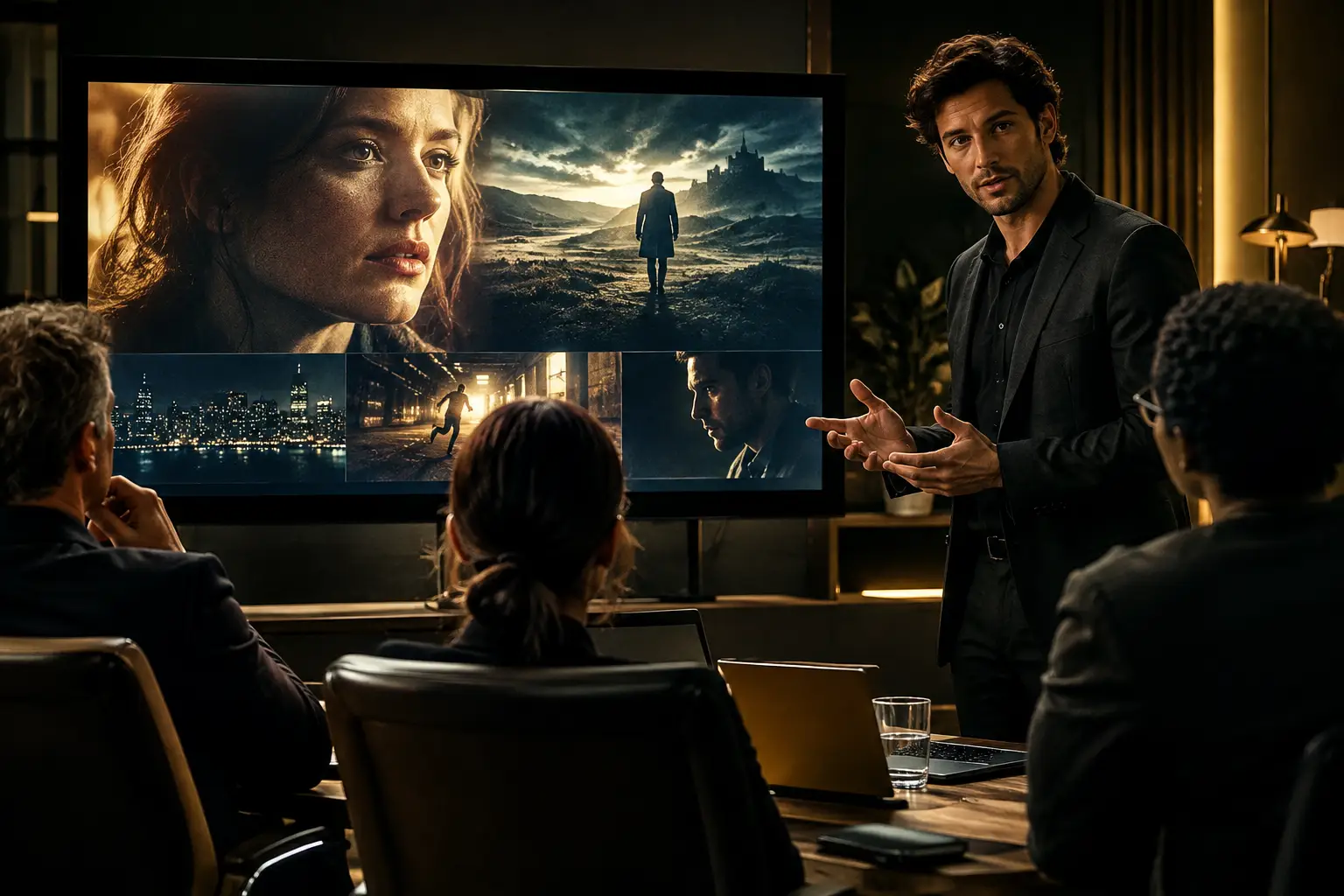
A decision-maker may read ten pages of coverage before they ever read ten pages of your script. A cinematic asset changes that equation. When the tone, central conflict, and commercial promise of a story can be felt in under two minutes, your screenplay stops being a document competing for attention and becomes a project people can see themselves making.
Knowing how to pitch a screenplay visually is not about illustrating every beat on the page. It is about creating a focused, Hollywood-quality proof-of-concept that gives producers, financiers, talent, and development partners an immediate emotional read on the film. The strongest visual pitch makes the audience ask the right question: How do we make the feature?
Start With the Sell, Not the Synopsis
A visual screenplay pitch is not a condensed version of the screenplay. It is a sales asset. That distinction determines every creative choice, from which scenes you reference to how long the final film runs.
A synopsis explains what happens. A movie pitch trailer creates a feeling about what could happen. It should establish the promise of the project: the world, the genre, the protagonist under pressure, and the scale of the experience. If someone watches your piece with the sound off, they should still understand whether they are looking at elevated horror, a contained thriller, a prestige drama, a family adventure, or a high-concept sci-fi property.
Start by identifying the one-sentence sell. Not the full logline, necessarily, but the emotional engine beneath it. A survival thriller may really be about a mother who refuses to abandon her child. A crime story may be about the price of loyalty. A science-fiction epic may be about the terror of discovering humanity is not alone.
That core idea becomes the filter for the visual pitch. If an image, line, or sequence does not amplify it, it does not belong.
Choose the Right Visual Format for the Project
Not every screenplay needs the same asset. The most effective format depends on where the project is in development, who needs to be persuaded, and what your story needs to prove.
A cinematic teaser is often the right choice when the concept is clean, genre-forward, and built around a strong hook. Think 30 to 60 seconds of atmosphere, iconic imagery, escalating tension, and a final reveal. It works well for projects that need to communicate tone fast, especially horror, thrillers, action, science fiction, and fantasy.
A movie pitch trailer, usually 60 to 120 seconds, gives more room for story. It can introduce the protagonist, define the central conflict, reveal the stakes, and build toward a memorable final button. This format is especially useful for producer outreach, investor presentations, packaging conversations, and early market validation.
A proof-of-concept film goes further. Instead of selling only the idea, it demonstrates that a crucial sequence, visual language, performance style, or tonal balance can work onscreen. This can be the smarter choice for a screenplay whose appeal depends on execution. A period drama, creature feature, emotionally complex drama, or visually specific fantasy world may need more than a trailer rhythm to persuade people.
The trade-off is focus. A longer proof-of-concept can establish credibility, but it also asks more of the viewer. If the project has one exceptional visual premise, a leaner trailer may create greater momentum than a short film trying to explain an entire mythology.
Build Around Three Things the Viewer Must Feel
A visual pitch earns its place in the room when it makes a decision-maker feel three things quickly: confidence in the concept, curiosity about the story, and clarity about the audience.
Make the Genre Immediate
Genre is not a label placed at the end of the trailer. It is communicated through image, sound, pacing, color, production design, and the way information is withheld or revealed.
For horror, that may mean a familiar place made threatening, a rule that should not be broken, and a sense of danger closing in. For a romantic drama, it may be intimate framing, charged silences, and a visual contrast between the life a character has and the life they want. For action, it may be propulsion, tactile environments, and a protagonist whose objective is instantly legible.
Avoid generic imagery just because it looks expensive. A polished city skyline, a dramatic close-up, or an explosion has little value unless it belongs specifically to your story world. The goal is not visual noise. The goal is recognition.
Reveal Stakes Without Explaining Everything
A common mistake is trying to fit the entire plot into the asset. The result is often a trailer that feels like a rushed recap rather than a compelling invitation.
Choose a single dramatic line. Show who the protagonist is before the story destabilizes them. Introduce the force working against them. Let the viewer understand what can be lost. Then leave enough unanswered that the feature feels necessary.
For example, a trailer for a conspiracy thriller does not need to reveal who orchestrated the conspiracy. It needs to show that the protagonist has uncovered something dangerous, that no one believes them, and that time is running out. That is enough to create story momentum.
Show Why This Story Has an Audience
Buyers are not only evaluating whether a screenplay is well written. They are assessing whether the project has a clear lane in the market.
Your visual pitch can communicate audience potential without resorting to a slide deck inside a trailer. Establish the scale of the world. Signal the genre conventions audiences expect. Show the emotional payoff the film promises. A contained thriller can look taut and producible. A fantasy project can feel expansive without trying to display every creature, kingdom, and piece of lore.
This is where restraint becomes an advantage. A visual asset should make the project feel intentional, not overstuffed.
How to Pitch a Screenplay Visually With a Strong Structure
The strongest movie pitch trailers are built like miniature films. They move, escalate, and land. While the exact rhythm depends on genre, a reliable structure often has four movements.
First, establish the normal world and the protagonist's point of view. This may only take a few shots and a line of dialogue. Next, introduce the disruption: the call, discovery, threat, opportunity, or impossible event that changes everything.
Then accelerate. Images become more urgent, the score builds, the opposition becomes clearer, and the stakes sharpen. Finally, end on an image, reversal, or line that stays with the viewer after the screen goes black. The final moment should not merely close the piece. It should create a reason to talk about it.
Dialogue should be sparse and purposeful. A single line with real character can carry more weight than five lines of exposition. If a voiceover is used, it should add perspective or tension, not narrate what the audience can already see.
Music and sound design matter just as much. They shape perception of production value, establish genre, and give cuts emotional force. Silence can be equally valuable when it creates anticipation before an impact.
Make the Script Translatable Before Production Begins
A visual pitch is only as strong as the creative brief behind it. Before production, define the elements that cannot be compromised: the protagonist's age and presence, the setting, visual references, the story's emotional temperature, and any signature images that make the concept distinct.
You should also be honest about what needs to be shown and what can be implied. A large-scale battle may be central to the screenplay, but the pitch asset may be more effective if it shows the aftermath, one defining confrontation, and the human cost. Suggesting scale can sometimes feel more cinematic than attempting to show every detail.
AI-powered production expands what is possible for development-stage projects, particularly when a conventional shoot is not practical. It can help creators visualize locations, characters, action, and worlds that would otherwise remain trapped on the page. But the technology is not the pitch. Creative direction, story judgment, editorial pacing, and cinematic taste are what turn generated imagery into a persuasive film asset.
That is why a done-for-you production process matters. The screenplay needs to be interpreted through the lens of trailer structure, cinematic design, sound, and audience psychology, then shaped into a finished piece with a clear purpose.
Use the Asset as Part of a Larger Pitch Package
A cinematic trailer does not replace the screenplay, treatment, lookbook, or pitch deck. It gives those materials a powerful front door.
Lead with the trailer in a meeting, at the top of a private presentation, or as the centerpiece of an investor conversation. Then use the script and supporting materials to answer the questions the film asset creates: What is the full story? What is the budget range? Who is the audience? Why is this project timely? What talent or attachments could elevate it?
The visual piece should make those conversations more productive because everyone in the room now shares the same reference point. They are no longer imagining the project in isolation. They are responding to a cinematic version of its potential.
A screenplay earns attention through its writing. A visual pitch can earn belief before the first scene is read. For creators ready to put their story in front of serious collaborators, a Hollywood-quality trailer or proof-of-concept gives the project a form people can feel, remember, and champion.