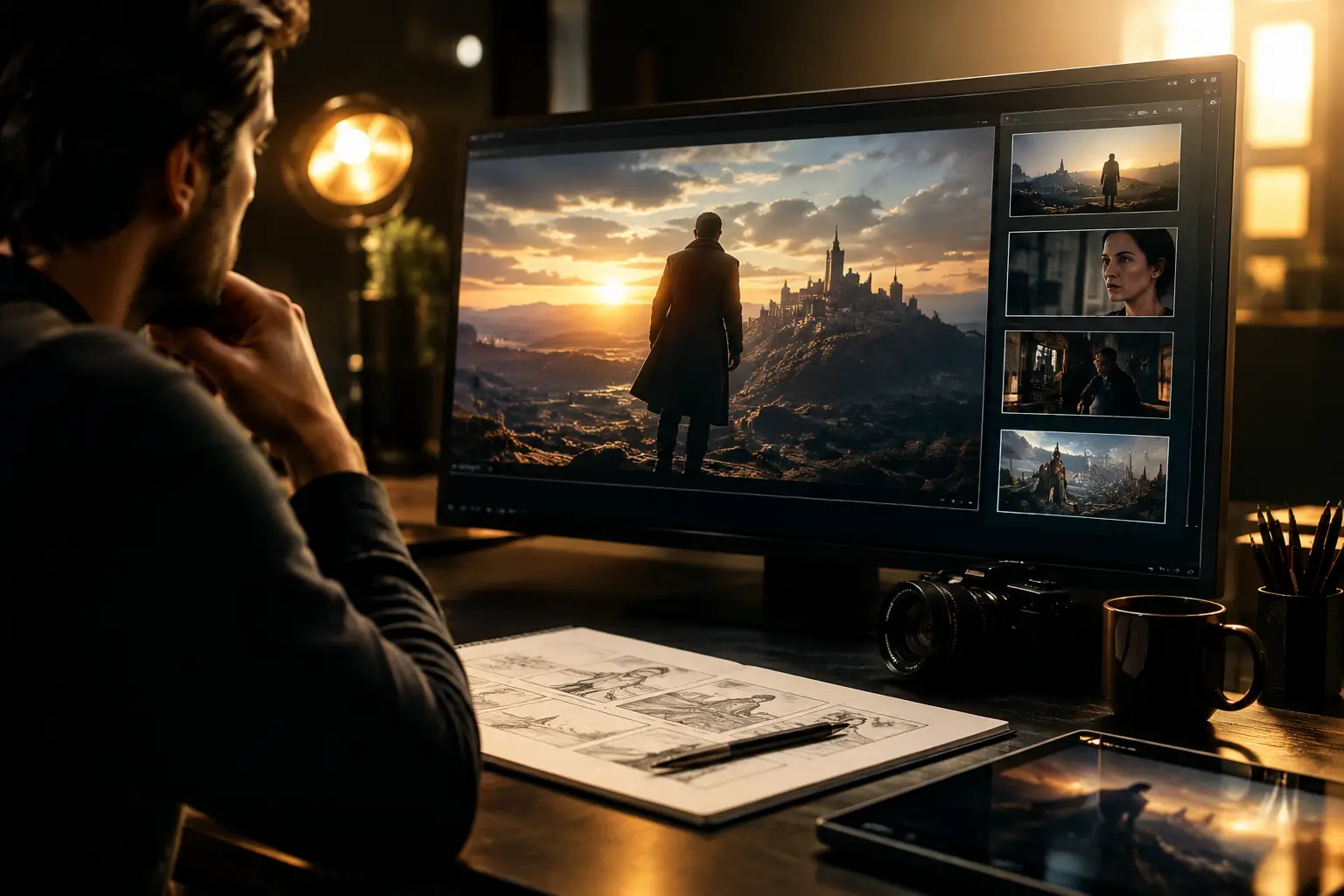
A strong screenplay can create a complete movie in the reader’s mind. The challenge is that development decisions are rarely made by one reader, in one room, with unlimited time. A screenplay visualization service gives your story a cinematic form that can be watched, shared, and felt before the feature exists. It turns pages into a proof-of-concept designed to communicate the experience of the film - its tone, scale, genre, emotional charge, and commercial potential.
For writers, producers, authors, and entertainment entrepreneurs, that shift matters. A polished visual asset can make a project easier to pitch to collaborators, financiers, publishers, talent, and development partners. It gives people something immediate to react to beyond coverage notes, loglines, and a verbal explanation of what the finished film could become.
A Script Is Not Always Enough to Sell the Experience
Screenplays are the foundation of a film, but they are not the finished medium. They ask the reader to interpret pacing, production design, performance, sound, camera language, and visual atmosphere from the page. An experienced producer may do that instinctively. A potential investor or strategic partner may not.
That gap can be costly when the project depends on a highly specific execution. A contained psychological thriller, elevated horror story, fantasy world, action concept, or character-driven drama may sound familiar in a synopsis yet feel entirely distinct once its visual identity is established. The question is not only whether the story works. It is whether the audience can instantly understand what makes this version worth making.
A cinematic screenplay visualization helps answer that question. Rather than attempting to condense every plot point, it identifies the moments that sell the project: the central conflict, the defining image, the emotional hook, the escalation, and the promise of the genre. The result is typically a trailer-format film or proof-of-concept that presents the project as an experience, not merely an idea.
What a Screenplay Visualization Service Actually Produces
The right deliverable depends on where the property sits in development and what it needs to accomplish. A project seeking financing may need a movie pitch trailer that establishes market position and cinematic scope. A producer considering attachments may need a proof-of-concept that makes the tone tangible. An author adapting a novel may need a book-to-film trailer that demonstrates how the story translates to the screen.
A screenplay visualization service generally creates a short-form cinematic asset from an unproduced script, treatment, book, or concept. It can include AI-powered imagery, character visualization, cinematic editing, sound design, music, motion, narration, titles, and selected dialogue. The objective is not to replace the screenplay. It is to create a high-impact companion asset that helps the screenplay travel farther.
The most effective visualizations are selective. They do not try to explain the entire second act or resolve every narrative thread. They build intrigue while clearly signaling the project’s identity. A crime thriller should create pressure and uncertainty. A romantic drama should establish chemistry and emotional stakes. A sci-fi story should make its world feel authored, not generic.
That distinction separates a cinematic visualization from a slideshow of concept art. The asset needs pacing, editorial judgment, and a trailer-minded understanding of audience expectation. Every image, line, sound cue, and transition should contribute to the story being sold.
Trailer, Teaser, or Proof-of-Concept?
These terms are often used interchangeably, but they can serve different strategic purposes. A teaser is usually shorter and more impressionistic. It is useful when the goal is curiosity, brand identity, or an early announcement. It may center on one unforgettable image, a key character, or a high-concept premise.
A movie pitch trailer provides more narrative clarity. It introduces the world, defines the central tension, and gives viewers a sense of the film they would be backing, producing, or watching. It is especially valuable for projects moving through development conversations where stakeholders need to see the commercial frame quickly.
A proof-of-concept can be more specific. It may test a signature sequence, establish the visual rules of the world, or prove that a challenging tonal blend can work on screen. For a project with an unconventional premise, an ambitious setting, or a distinct visual language, this can be the most persuasive option.
There is no universal best format. The best choice depends on the audience, the stage of development, and the decision you need the asset to support.
Where Visualization Creates Leverage
A finished cinematic asset can create momentum in places where a script alone has limited reach. It can open a pitch meeting, strengthen a deck presentation, support a financing conversation, or give a producer a clearer way to introduce the project to their network. It can also help align the creative team before significant resources are committed.
For screenwriters, visualization can clarify whether the movie on the page is delivering the intended promise. Watching the concept unfold may reveal that the hook needs a stronger image, that the antagonist needs a clearer presence, or that the story’s emotional center deserves more emphasis. This is not a replacement for script development, but it can provide a valuable new perspective on the material.
For authors and IP owners, a visual proof-of-concept can make an adaptation conversation more concrete. A book contains internal voice, backstory, and world-building that may take hours to absorb. A cinematic trailer can introduce the screen potential in minutes while preserving the emotional identity that made the source material compelling.
For producers and entertainment entrepreneurs, the asset becomes a development tool. It gives a project a polished, shareable presence while the feature is still being packaged. That can be particularly useful when conventional production is not yet justified by the budget, schedule, or level of commitment.
The Value of an End-to-End Production Partner
Creating a visualization is not simply a matter of generating attractive images. It requires decisions about adaptation, visual continuity, character identity, shot selection, pacing, music, sound, and narrative economy. Without a unified creative direction, a short film can feel like disconnected moments rather than one coherent piece of entertainment.
A done-for-you studio handles that translation from source material to finished cinematic asset. The process begins with the project’s strategic purpose: Is the goal to attract financing, secure interest, validate a concept, promote existing IP, or build anticipation around a pitch? From there, the creative approach can be shaped around the audience that needs to respond.
The next stage is editorial. The studio identifies the strongest dramatic spine and selects the scenes, images, and lines that can carry the trailer. This may mean departing from the screenplay’s chronological order. Trailer storytelling often works best when it builds from premise to tension to escalation, then leaves the viewer with a question they want answered.
Visual development follows. Characters, environments, lighting, color, camera language, and production design need to feel like they belong to the same film. AI-powered production methods can accelerate this process and make Hollywood-quality visual development more accessible, but the technology is only part of the equation. The creative standard still depends on taste, direction, and a clear understanding of cinematic storytelling.
Blackline Creative Group approaches this work as a production service, managing the path from story material to finished trailer-format film. That matters for creators who need a professional result without assembling separate specialists for concept art, editing, music, motion design, and post-production.
What to Prepare Before You Begin
The strongest projects begin with clear source material and a clear outcome. A finished screenplay is ideal, but a treatment, manuscript, outline, or developed concept can also provide a strong starting point. What matters most is that the core story and its intended audience are defined.
Before commissioning a visualization, be prepared to articulate the project’s genre, comparable titles, target viewer, and primary business purpose. If the project is a creature feature, for example, the trailer needs different promises than a prestige drama. If it is aimed at investors, it may need more clarity around scope and audience. If it is intended for social promotion, it may need a sharper opening and a more immediate hook.
It also helps to identify what must remain true to the property. That could be the protagonist’s emotional journey, the look of a signature location, the story’s period setting, or a specific reveal. At the same time, allow room for the trailer to function as its own dramatic piece. A visualization earns attention by distilling the story, not by reproducing every page.
Judge the Asset by the Response It Creates
The success of a screenplay visualization is not measured only by whether every detail matches an imagined shot list. It is measured by whether the intended viewer understands the project faster, feels something specific, and wants to know more.
A strong asset should make the genre legible within seconds. It should establish a memorable visual point of view, deliver a coherent emotional build, and leave the audience with a clear sense of why the project belongs in the market. For a pitch, it should make the conversation more focused. For promotion, it should create anticipation. For development, it should help the team see the same film.
The feature may still be years away. That does not mean the story has to remain invisible. Give the right people a reason to see it before the cameras ever roll.